
On this page ↓
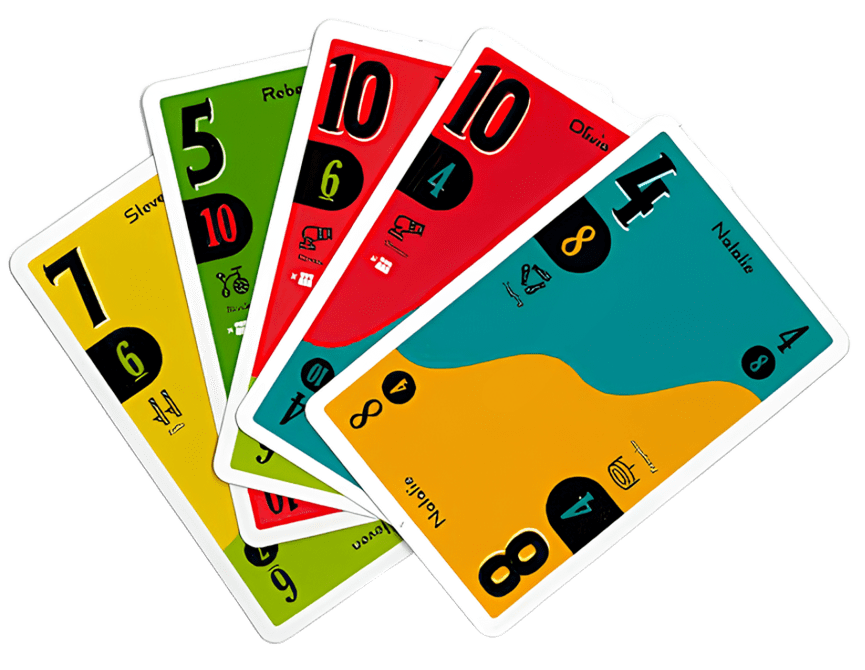
Play one card or a connected group from your hand. Beat the active set to collect its cards as points. Take a card from either end of the active set. Flip it if you like, then place it anywhere in your hand. Numbers have two sides. At the start of each round, choose the orientation of your entire hand. After that, you can't reorder or turn those cards. Scout wisely to build a winning sequence.
SCOUT rules at a glance
SCOUT is a climbing card game for 2–5 players. On your turn you either Show a group of adjacent cards that beats the group on the table, or Scout one card from an end of that group into your hand. In a 3–5-player game you can use your once-per-round Scout & Show action to do both. The catch is that you may never rearrange the cards already in your hand.
Earn points from captured cards and Scout chips, avoid cards left in your hand, and finish with the highest score after the scheduled rounds. No memorization is necessary: the comparisons are always made in the same order—number of cards, type of combination, then its value.
What comes in the box and how to set up
The physical game contains 45 two-number cards, Scout chips, score chips, Scout & Show chips and a starting-player marker. Every card shows a different number at each end, and every unordered pair of numbers from 1 to 10 occurs once in the full deck. Cards are dealt in the order they arrive. Do not sort your hand by number or change individual cards’ direction.
Use all 45 cards with five players (9 per player). With four players, remove the 9/10 card (44 cards; 11 each). With three, remove the nine cards containing 10 (36 cards; 12 each). With two, also remove 9/10 and deal 11 cards per player for each of two rounds, saving the other 22 cards for round two. The two-player turn structure is different; see the dedicated section below.
In a 3–5-player match give everyone one Scout & Show token per round. Put the Scout chips within reach. Choose a starting player; this role passes to the next player each round.
| TOTAL PLAYERS | YOUR HAND |
|---|---|
| 2 | 11 |
| 3 | 12 |
| 4 | 11 |
| 5 | 9 |
The rule that makes SCOUT different: never reorder your hand
After receiving cards, look at the order in which they were dealt. Before the round begins you may rotate your entire hand 180 degrees so every card shows its other number, in reversed reading order. Make this choice once. From then on you cannot shift, swap or individually flip cards already in your hand.
For example, imagine your hand contains 3 · 3 · 4 · 5 · 8 in that order. You can Show the adjacent 3 · 3 pair or the adjacent run 3 · 4 · 5. You cannot take a 3 and the 8 and move them next to each other. When you Scout a fresh card, however, you may flip that newly taken card and insert it between any two existing cards, or at either end. That is your main way to improve the hand without breaking the order rule.
How to Show cards and beat the active set
A Show places one card, or a legal group of two or more adjacent cards from your hand, face up on the table. A group must consist of equal values (such as 7–7–7) or a run of consecutive values in ascending or descending order (such as 3–4–5 or 8–7–6). A single card may come from any hand position.
The current face-up group is called the active set. If there is no active set, any legal Show is allowed. Otherwise, you must beat it using these rules, in order:
- More cards wins: four consecutive cards beat any three-card set, even three matching high cards.
- At the same size, equal numbers beat a run: 2–2–2 beats 7–8–9.
- At the same size and type, compare the lowest number: 5–6–7 beats 3–4–5, and 8–8 beats 6–6.
There is no tie-breaker after that: identical strength does not beat the active set. On a successful Show, you take the former active cards face down as your captured cards (each will score one point), and your played cards become the new active set.
SCOUT combination strength: worked examples
Example 1 — quantity: the table has 8–8–8 (three equal cards). You have 1–2–3–4 in adjacent hand positions. Your four-card run wins because it uses more cards.
Example 2 — type: the table has a run 6–7–8. You have 2–2–2 in adjacent positions. With three cards on each side, the matching trio wins even though 2 is lower than 6.
Example 3 — value: the table has 3–4–5 and you can Show 4–5–6. Both are three-card runs, so compare their smallest values: 4 beats 3.
Example 4 — tie: the table shows 5–5 and your hand also has an adjacent 5–5. Equal strength cannot replace the active set; you must find a stronger set or Scout.
How Scout works: recruit and insert a card
Instead of showing cards, choose the leftmost or rightmost card of the current active set and take it into your hand. You cannot take a card from the middle. Before inserting it, you may turn the recruited card around to use its other number. Insert it at the start, the end or any gap between cards—without moving the other cards. In 3–5-player games, the owner of the active set earns a Scout chip for this action.
Suppose your hand has 4 · 5 · 7. You Scout a card showing 6 on one side and another value on the other. Turn it to 6 and place it between 5 and 7. You now have the adjacent run 4 · 5 · 6 · 7, ready for a later Show. If the scouted card was the last one in the active set, the table is cleared; the next player may Show any valid set.
In the regular 3–5-player game, Scout ends your turn. You do not also Show unless you spent your Scout & Show token.
When to use Scout & Show
In a game of three, four or five players, you receive a Scout & Show token once per round. Spend it to Scout one end card from the active set and then immediately Show a legal set. The card you Scouted may be part of that set; this lets you recruit the missing number and put the improved combination down before another player acts.
The token cannot be reused that round. If any active cards remain after the Scout part, your Show still has to beat that remaining set. There is no Scout & Show action in the official two-player version.
Exactly when a round ends
A standard round ends immediately in either of two situations. First: somebody plays their last hand card in a Show, emptying their hand. Second: after a player Shows, every other player in turn Scouts instead of beating that Show. When the turn would come back around to the Show’s owner, that unchallenged Show ends the round. This can happen while the winner still holds cards.
The distinction matters for scoring: the owner whose Show remains undefeated when everyone else has Scouted does not lose points for cards still in their hand. All other players count their hand cards normally. The active set itself does not score as captured cards.
SCOUT scoring explained with a complete example
Add one point for each captured card and one point for each Scout chip you own, then subtract one point for each card still in your hand. A used Scout & Show token does not score. The face-up active set does not count as a capture. The special exception is the player who ended a round with an unbeaten Show after all others Scouted: that player ignores the hand-card penalty.
Worked example: you collected 7 cards, received 2 Scout chips and hold 4 cards when someone else ended the round. Your score is 7 + 2 − 4 = 5. If your Show was the one nobody beat, the same cards and chips produce 7 + 2 = 9, because the 4 remaining hand cards do not count against you.
Round scores can be negative. Play as many rounds as there are players in a standard multiplayer match, shifting the starting player each time. After the final round, add round scores together; the highest cumulative score wins.
| CAPTURED | SCOUT | LEFT | ROUND |
|---|---|---|---|
| +7 | +2 | −4 | 5 |
Score example
How to play SCOUT with two players
The two-player rules are not simply the usual multiplayer rules with one opponent. Remove the 9/10 card, deal 11 cards to each player for round one and set aside the other 22 cards for round two. The match lasts two rounds, with the starting player alternating.
Each player starts each round with three Scout chips. There is no Scout & Show token. If you Scout, you spend one of your own chips into the center and keep taking your turn: you may Scout again or Show; you have not passed to the opponent. You cannot Scout once you have spent all three chips. In two-player games, taking an opponent’s active card does not give that opponent a new Scout chip.
A round ends when someone empties their hand with a Show or when the active player can neither make a legal Show nor Scout (because no chips remain). Unspent Scout chips score one point each, on top of captured-card points and applicable hand penalties. The second round uses the reserved 22 cards.
Common mistakes and how to avoid them
- Rearranging cards: never slide original hand cards into a better order. Only a newly Scouted card can be inserted freely.
- Taking the middle card: Scout is limited to the two ends of the active group.
- Ignoring length: a longer Show wins before type or numbers are considered.
- Assuming the highest card wins: when comparing two runs of equal length, compare their lowest card, not the highest face alone.
- Scoring the active set: only captured face-down cards count as capture points.
- Using multiplayer rules in a duel: two players have three spendable Scout chips, consecutive turns after Scout and no Scout & Show.
Beginner strategy: make every Scout count
Before making a move, scan for the longest matching group or consecutive run already in your hand. Consider whether Scouting one end card could bridge a missing number. In a four-card potential run such as 2 · 3 · 5 · 6, a recruited 4 can turn two weak groups into one much stronger Show.
Do not automatically Scout every turn: each Scout often awards a point to the active-set owner. Likewise, do not spend your once-per-round Scout & Show token on a small improvement when a later recruitment could produce a decisive combination. Balance capturing cards now against preserving enough flexibility to avoid an expensive hand at round end.
There is no guarantee of winning a round: opponents choose when to Show or Scout, and the cards they reveal may change the opportunities available. Good play means using the information in your hand, the current active set and the remaining number of opponents.
Play SCOUT online against bots
You can try these rules without setting up a physical deck: play SCOUT online here against one to four computer opponents. Choose the number of players and a bot difficulty, then start a match. The interface preserves your hand order, highlights selectable groups and walks you through taking a card from an end of the active set and inserting it into a chosen gap.
Guest play is free. Signing in with Google enables a personal dashboard, achievements and ranked completed matches. This site is an independent fan-made adaptation and is not affiliated with Oink Games. For the physical game, consult the publisher’s official SCOUT page.
Frequently asked questions about SCOUT
What is the main goal in SCOUT?
Play stronger adjacent combinations, collect captured cards and Scout chips, and finish with the highest total across the rounds.
Can you rearrange cards in your hand?
No. You may rotate the entire hand once before a round, but you cannot change the order of existing cards afterward. A newly Scouted card can be inserted anywhere.
Can you choose which side of a card is up?
You can rotate the entire starting hand before the round. When you recruit a card by Scouting, you may choose that card’s orientation before inserting it.
What combinations are legal in a Show?
A single card, adjacent cards with matching values, or adjacent cards forming an ascending or descending consecutive run.
What beats what in SCOUT?
More cards beat fewer. At equal length, matching numbers beat a run. At equal length and type, compare the lowest visible number; the higher one wins.
Can a tie beat the active Show?
No. If your combination has equal strength to the active set, it does not beat it.
Can you Scout a card from the middle?
No. Choose one card from either end of the active set.
Can I Scout and Show in one turn?
Yes, once per round with the Scout & Show token in games with 3–5 players. That action is unavailable in the two-player rules.
Does Scouting give an opponent a point?
In games with 3–5 players, the owner of the active set earns one Scout chip worth one point. In the two-player variant, the active-set owner does not receive that chip.
When does a SCOUT round end?
It ends when a player empties their hand with a Show, or when every other player Scouts rather than beats the most recent Show. In two-player games, it can also end when the active player cannot Show or Scout.
How many rounds do you play?
Normally, as many rounds as there are players: 3, 4 or 5. A two-player game lasts 2 rounds.
Do you lose points for leftover cards?
Usually yes: each leftover hand card is −1. The owner of an unbeaten Show that ends the round after everyone else Scouts does not take that hand-card penalty.
How many cards are there in SCOUT?
The complete deck has 45 double-number cards. Different player counts remove certain cards before dealing: 3 players use 36, 2 or 4 players use 44, and 5 players use all 45.
Can SCOUT be played solo?
The physical rules are for 2–5 people. On this website you can be the only human playing against 1–4 bots.
Can I play SCOUT without downloading anything?
Yes. Open the SCOUT web game, choose your opponents and start a free guest match directly in your browser.
Try SCOUT online
Practice these rules in a free browser game against 1–4 bots.
An independent, fan-made digital adaptation. SCOUT is a game by Kei Kajino, published by Oink Games. Not affiliated with Oink Games. OFFICIAL GAME ↗